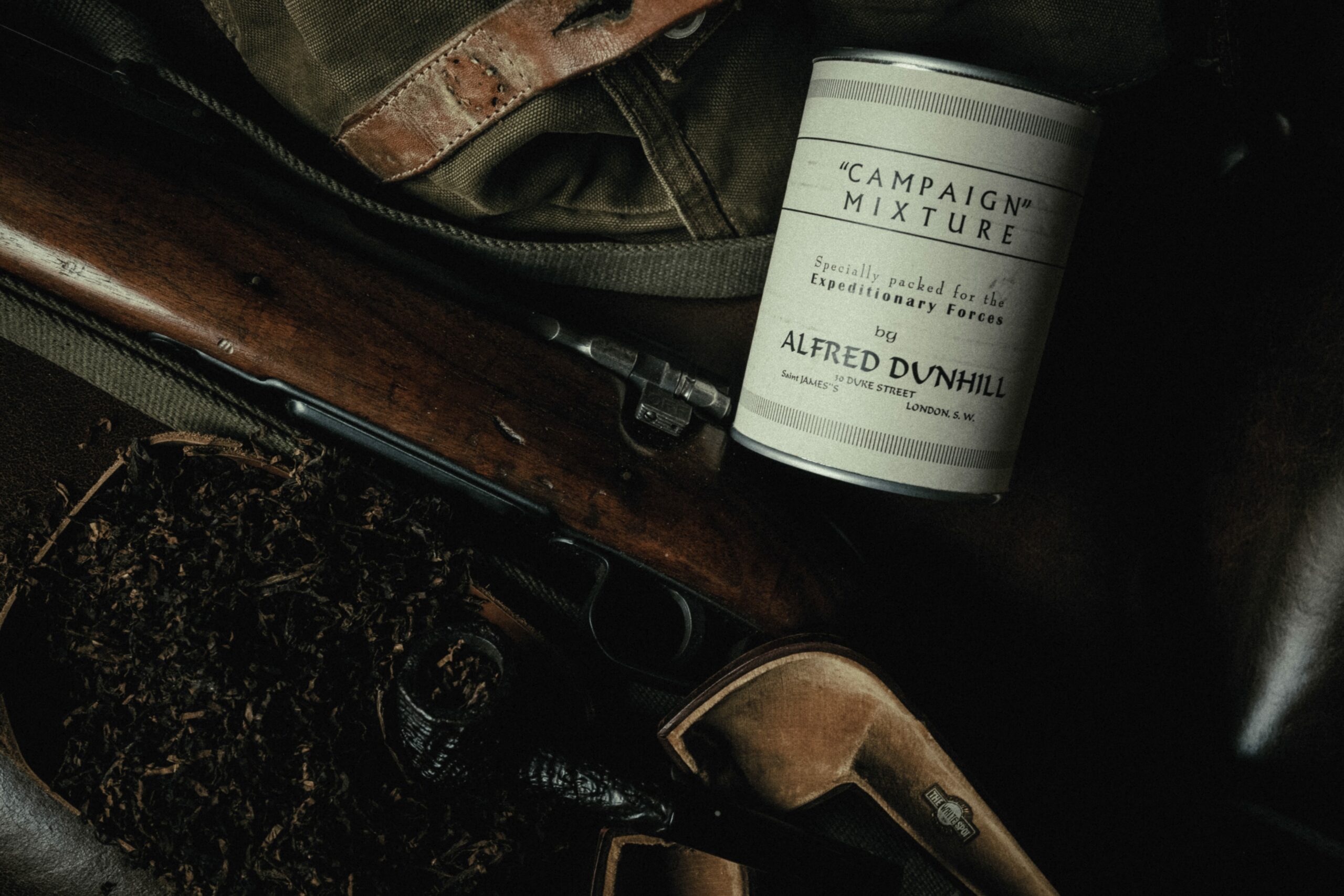
WWI Alfred Dunhill “Campaign” Mixture | Expeditionary Forces | Original Tin + Tobacco
Going for $36.00 [25 Bids]
Reserve: [n/a]Winning: Pipe14142014
- Watch this auction
- Bid $37.00 or higher
- First Bid: 1 day ago
- Last Bid: 9 hours ago
- Shipping: n/a
Ends:
Days
Hours
Minutes
Seconds
Description
Somewhere in France, a man struck a match. Perhaps it was beneath the broken roof of a billet, beside a road churned to mud by boots, horses and guns, or during one of those brief quiet stretches after dusk when the thunder had moved farther down the line and a soldier could draw on his pipe, warm his hands around the bowl, and remember England. The Great War was consuming Europe, and at 30 Duke Street, Saint James’s, London, Alfred Dunhill was packing a tobacco for men serving overseas. Its name was “Campaign” Mixture, and the label stated its purpose in words that remain as powerful today as they must have been then: “Specially packed for the Expeditionary Forces.”
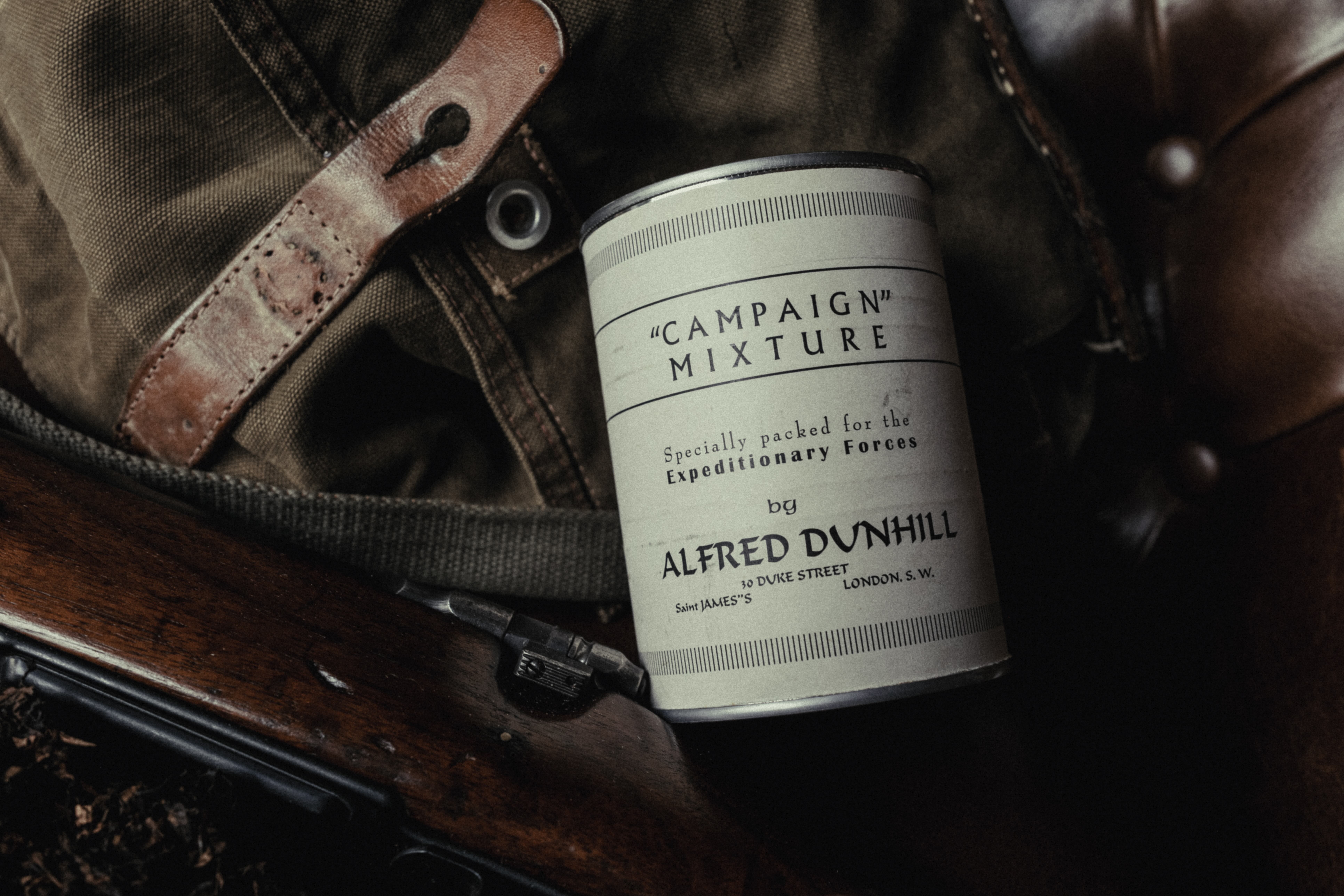
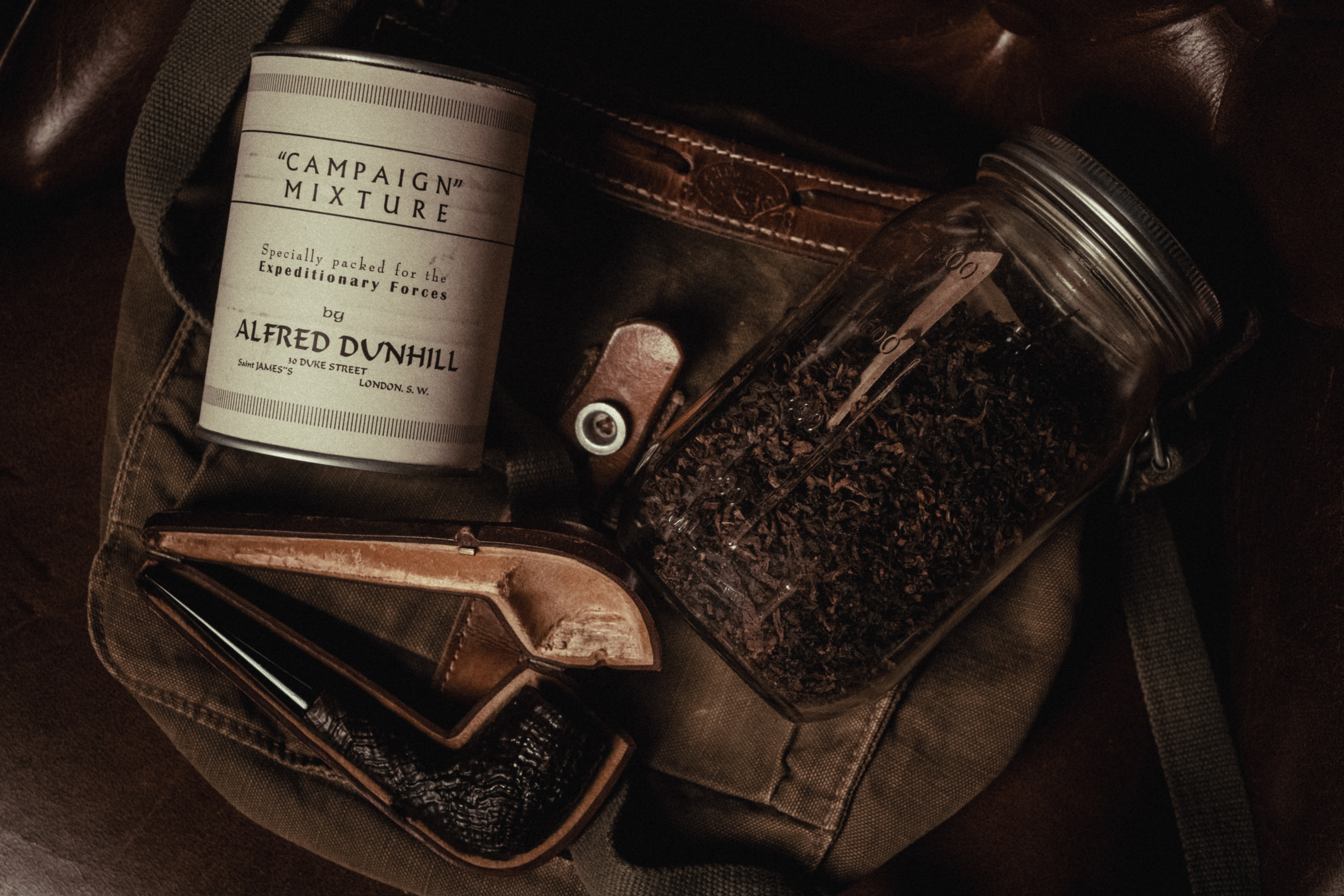
Offered here is the original empty Alfred Dunhill “Campaign” Mixture tin shown in the photographs together with the surviving tobacco contents removed from that exact tin and preserved in the glass Mason jar shown. I opened this extraordinary tin publicly on my Pipe Appeal YouTube channel, sampled only one bowl, and then transferred the remainder to glass, where it has been kept with a 65% Boveda humidity pack. The original tin and its surviving contents are being offered together.
For me, this was not simply another old tobacco opening. It was one of the rarest and most historically significant tobaccos I have ever had the privilege to handle. Campaign Mixture belongs to one of the most obscure chapters in Alfred Dunhill history. The late John C. Loring, whose extensive research traced Dunhill tobaccos through surviving catalogs and historical records, places Campaign Mixture in the First World War period, approximately 1915 to 1918, and records its blend type simply as unknown. It was one of three temporary wartime tobaccos associated with Dunhill’s provision for the fighting forces: Campaign Plug, Campaign Mixture, and Best Scotch Thick Black Twist.
These were not merely ordinary civilian blends given martial names. During the First World War, Dunhill made special provision for the Expeditionary and Naval Forces, offering established tobaccos at preferential prices and introducing temporary wartime tobaccos for service use. Historical research records Campaign Mixture at five shillings per pound, while Campaign Plug was offered for still less. Dunhill even offered a low cost Campaign Pipe in bulk quantities for wartime distribution. The surviving label speaks directly to that purpose: “CAMPAIGN” MIXTURE, “Specially packed for the Expeditionary Forces,” by Alfred Dunhill, 30 Duke Street, Saint James’s, London, S.W.
Campaign Mixture is remarkable for another reason. Loring’s research records that in 1916, Campaign Mixture alone was offered in a new sealed form, in a four ounce tin approximately four inches tall and described as being in the style used for Rattray’s blends. By the following year, related sealed packaging had spread to other Dunhill mixtures. Separate histories of Dunhill tobacco likewise connect Campaign Mixture in 1916 with the company’s early adoption of fully sealed airtight packaging.
The original tin offered here measures approximately 4½ inches tall by 3¼ inches in diameter. When I opened it, the construction was unusual. Beneath a separate removable outer lid was a sealed metal end that I opened with a conventional can opener, and inside, the tobacco itself was contained in a paper bag. I have personally handled and opened a number of genuinely old tobaccos, including familiar cutter top tins from the 1930s and 1940s, and this package did not feel identical to those later forms.
For that reason, I want to be completely transparent: the exact packing year of this individual tin is not stamped and cannot be proved from the object alone. What can be documented is extraordinary enough. Campaign Mixture belongs to Dunhill’s First World War history, Loring records the blend in the wartime period, and he specifically describes a tall sealed four ounce Campaign package in 1916. In all of my searching, I have found no convincing documentation of a later cataloged return of the blend. Rather than claim a precision that history has not preserved, I prefer to present the surviving evidence honestly and allow the collector to draw his own conclusion about the exact age of this individual example.
Perhaps the greatest mystery is the tobacco itself. The surviving Dunhill chronology does not preserve a known formula for Campaign Mixture and records its blend type simply as unknown. That is remarkable in its own right. Dunhill mixtures have been studied, cataloged, compared and debated for generations, and names such as My Mixture 965, Nightcap and Early Morning Pipe became landmarks of the pipe world. Campaign Mixture, by contrast, appears in the wartime record and then seems to disappear almost completely. No reliable historical formula has been found, and no definitive component list has been established.
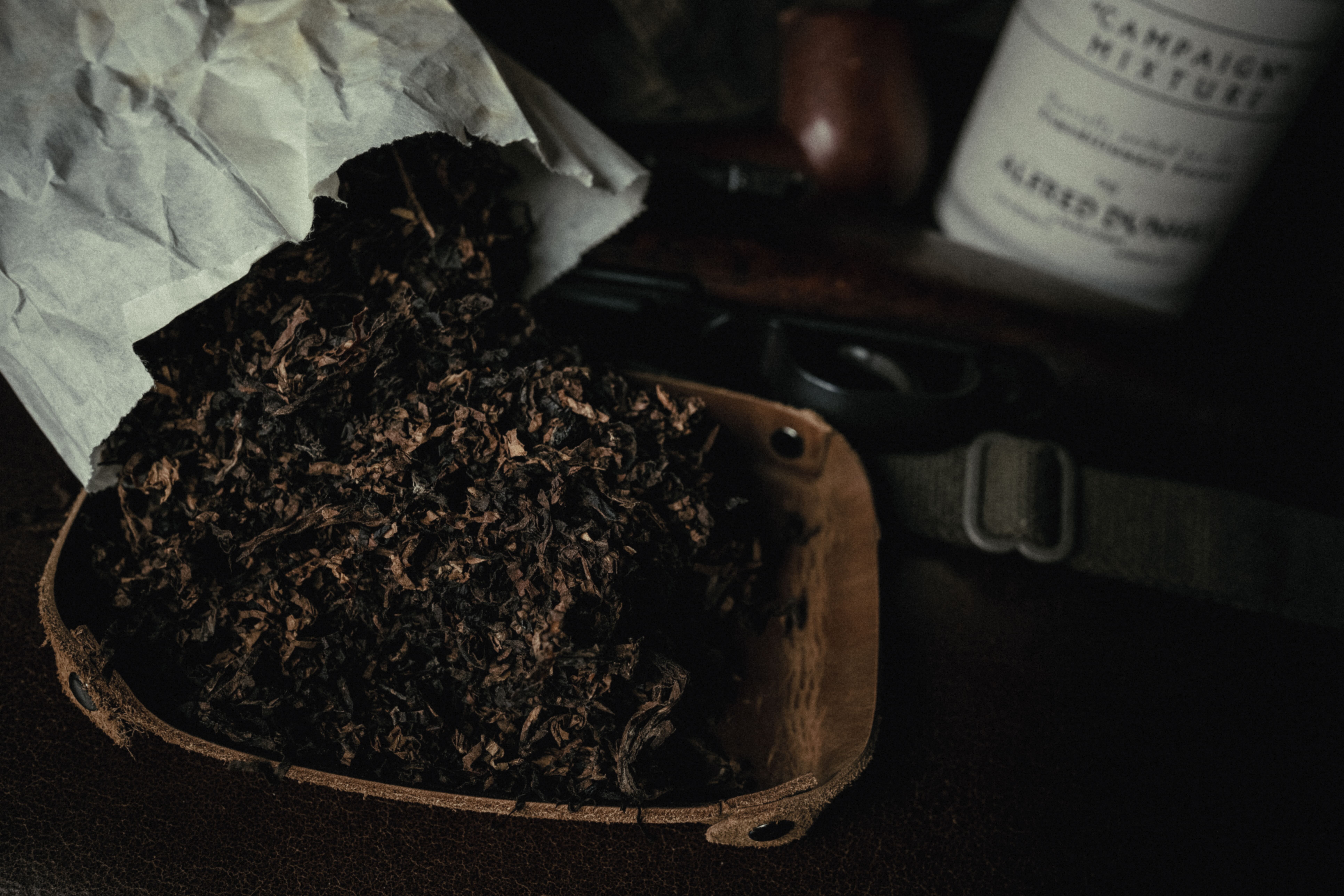
When I opened this tin for Pipe Appeal, I sampled only one bowl. The tobacco itself was astonishing. Visually, the mixture showed a remarkable range of leaf, from lighter brown and reddish strands through deeper brown and nearly black pieces, and after its extraordinary age it remained expressive, complex and very much alive. Because the historical recipe is unknown, I will not pretend to identify the components as fact, but in the single bowl I smoked I personally found suggestions of deeply matured Virginia sweetness, fragrant Oriental character, smoky leaf reminiscent of Latakia, and perhaps a darker processed component. The tobacco carried impressions of sweet stone fruit, old leather, incense smoke and deep nutty earth. Those are my personal tasting impressions only, not a claimed historical recipe, but I can say without hesitation that the tobacco was exceptional.
I have smoked many celebrated old blends over the years, but this was different. There was no established legend telling me what I was supposed to taste and no familiar recipe to compare it against. For a few minutes, the tobacco had to speak for itself. After that one bowl, I stopped. I could not bring myself to casually smoke through something this rare, so the remainder was transferred to the Mason jar shown and preserved with a 65% Boveda humidity pack.
It is difficult today to fully understand what tobacco meant in the daily life of the First World War soldier. For men serving with the British Expeditionary Force, smoking was woven deeply into the routines of service. Tobacco crossed the Channel in official supply, private parcels, charitable collections and gifts from home, while pipes and cigarettes offered warmth, familiarity, companionship and a few minutes of ordinary ritual amid conditions that had stripped ordinary life almost completely away. A pipe could not stop the guns, dry a trench, mend a wound or shorten the distance home, but it could give a man a few quiet minutes that still felt like his own. That is the world from which Campaign Mixture came, not as modern military nostalgia or retrospective branding, but as a Dunhill tobacco whose surviving label still bears the words “Specially packed for the Expeditionary Forces.”
I opened this tin publicly on my Pipe Appeal YouTube channel, and the video features the original tin, the opening, and the tobacco:
https://www.youtube.com/watch?v=K3Hmtor943c
For the episode, I paired the tobacco with my 1923 Dunhill Shell Briar LB, one of the oldest Dunhill pipes in my collection and a pipe I felt worthy of the occasion. The opening remains one of the most memorable I have ever filmed, not simply because of the rarity of the tobacco, but because of how little of its story has survived and how extraordinary it was to experience even one bowl from a blend whose composition is still unknown.
The winning bidder will receive the original empty Alfred Dunhill “Campaign” Mixture tin shown in the photographs, the surviving tobacco contents removed from that exact tin and preserved in the glass Mason jar shown, and the 65% Boveda humidity pack currently kept with the tobacco. Only one bowl was removed and sampled by me before the remainder was jarred. The original package and tobacco therefore remain together, carrying forward a story that began in the shadow of the Great War and survived long enough to be opened, smoked once, and preserved again.
I have had the privilege of opening many old and rare tobaccos over the years, including mixtures from vanished houses, forgotten blenders and celebrated eras of the pipe, but this one has never left me. It is an obscure Alfred Dunhill wartime mixture associated with the Expeditionary Forces, a blend whose formula has disappeared from the historical record, and a surviving example whose original tin and tobacco contents are still together. More than a century after the name first appeared, the old words remain on the label: “CAMPAIGN” MIXTURE, “Specially packed for the Expeditionary Forces.”
Swell smokes, my friends.

Auction Information
Pipe14142014 bid $36.00July 7, 2026 3:25 pm
alberto59 bid $35.00July 7, 2026 3:25 pm [auto]
Pipe14142014 bid $35.00July 7, 2026 3:25 pm
alberto59 bid $26.00July 7, 2026 3:25 pm [auto]
Pipe14142014 bid $25.00July 7, 2026 3:25 pm
alberto59 bid $15.50July 7, 2026 3:24 pm [auto]
Pipe14142014 bid $15.00July 7, 2026 3:24 pm
alberto59 bid $10.50July 7, 2026 3:17 pm
Pipe14142014 bid $6.75July 7, 2026 3:15 pm [auto]
alberto59 bid $6.50July 7, 2026 3:15 pm
Pipe14142014 bid $6.25July 7, 2026 2:57 pm [auto]
Uhlaner1 bid $6.00July 7, 2026 2:57 pm
Pipe14142014 bid $5.25July 7, 2026 2:52 pm
antples bid $5.00July 7, 2026 2:52 pm [auto]
Pipe14142014 bid $5.00July 7, 2026 2:52 pm
antples bid $3.10July 7, 2026 2:52 pm [auto]
Pipe14142014 bid $3.00July 7, 2026 2:52 pm
antples bid $1.90July 7, 2026 2:52 pm [auto]
Pipe14142014 bid $1.80July 7, 2026 2:52 pm
antples bid $1.60July 7, 2026 2:52 pm [auto]
Pipe14142014 bid $1.50July 7, 2026 2:52 pm
antples bid $1.40July 7, 2026 2:51 pm [auto]
Pipe14142014 bid $1.30July 7, 2026 2:51 pm
antples bid $1.10July 7, 2026 12:19 am
TW111 bid $1.00July 7, 2026 12:18 am


Shipping: $17.15
From: n/a
To: n/a