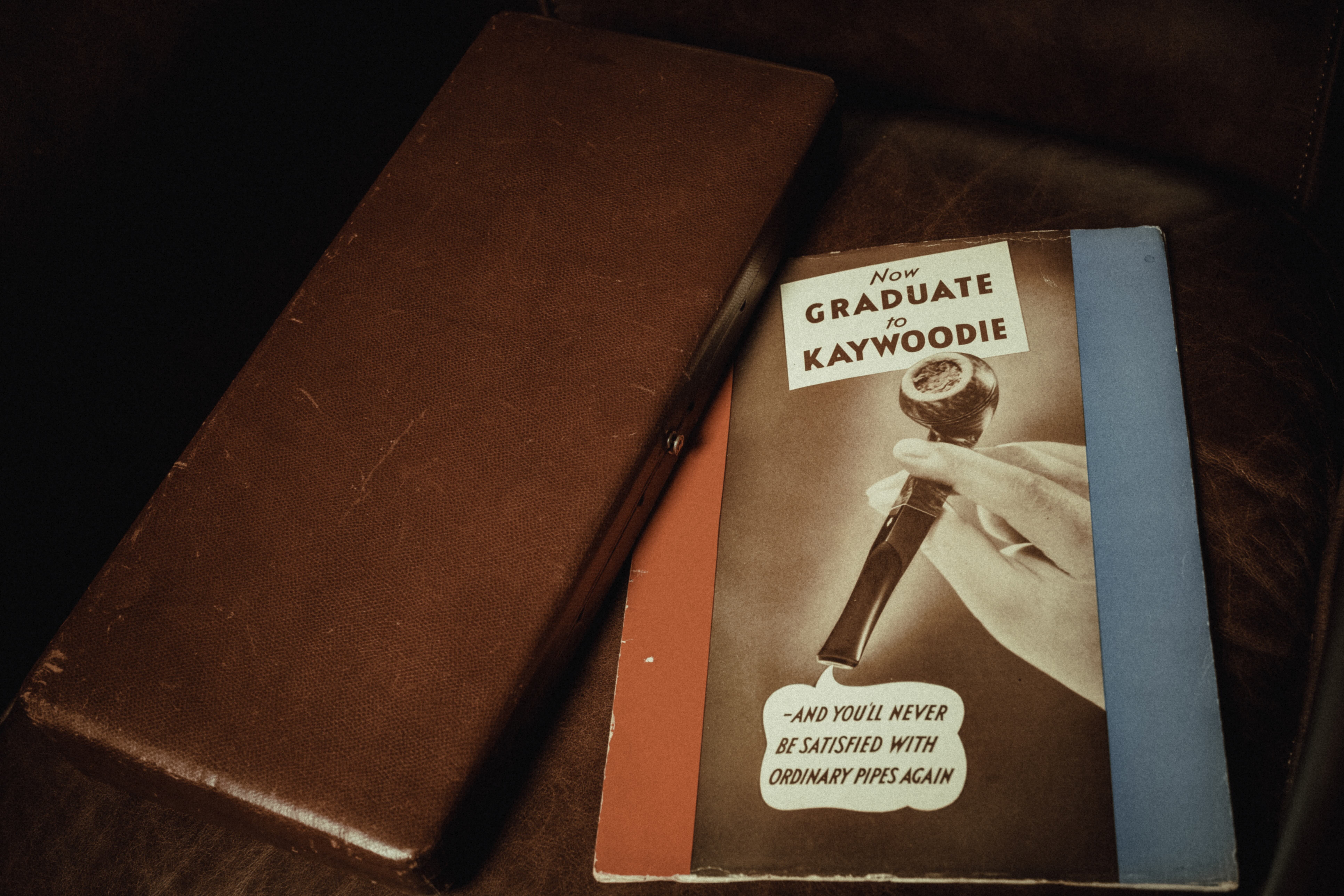
Late 1930s Kaywoodie Matched Grain Seven-Day Set, Unsmoked
Going for $1,995.00 [1 Bids]

Reserve: [Not met]Winning: Pipe14142014

$ USD
  • Watch this auction
  • Bid $2,005.00 or higher
  • First Bid: 2 hours ago
  • Last Bid: 2 hours ago
  • Shipping: n/a

Ends:


Days


Hours


Minutes


Seconds

Description

    There are certain luxuries which belong entirely to a man himself. The evening newspaper. The favorite chair beside the lamp. The quiet hour after the day’s work has been completed and the demands of business have finally yielded to peace and reflection. In such moments the pipe has long occupied a place unlike any other possession, for no companion serves more faithfully nor rewards more generously than a good pipe chosen at the proper hour.

    During the closing years of the 1930s, when America was emerging from the hardships of the Depression and looking once more toward prosperity, the Kaywoodie Company introduced something that many pipe smokers had long believed impossible. For generations it had been accepted as fact that no two pipes could ever truly be alike. Each piece of briar possessed its own individuality, its own grain, its own character. Yet from immense reserves of carefully selected imported briar, accumulated over decades and drawn from ancient Mediterranean roots, Kaywoodie undertook the remarkable task of assembling pipes whose grain, color, texture, and appearance belonged not to themselves alone, but to one another.

    Thus was born the Matched Grain.

    The company itself admitted that it scarcely believed such a thing could be accomplished. Only from millions of pieces of briar, patiently sorted and reserved over many years, could a small number of truly matched pipes ever be assembled. From these extraordinary selections came perhaps the most ambitious offering in the company’s history: the Seven-Day Set.

    By 1937 these magnificent presentations were being offered to the American pipe smoker at the extraordinary price of one hundred dollars. Adjusted for inflation, that figure exceeds two thousand three hundred dollars today, placing the Matched Grain Seven-Day Set among the great luxury smoking articles of its day. At a time when many Americans still measured every dollar carefully, Kaywoodie openly acknowledged that only a fortunate few would ever possess one.

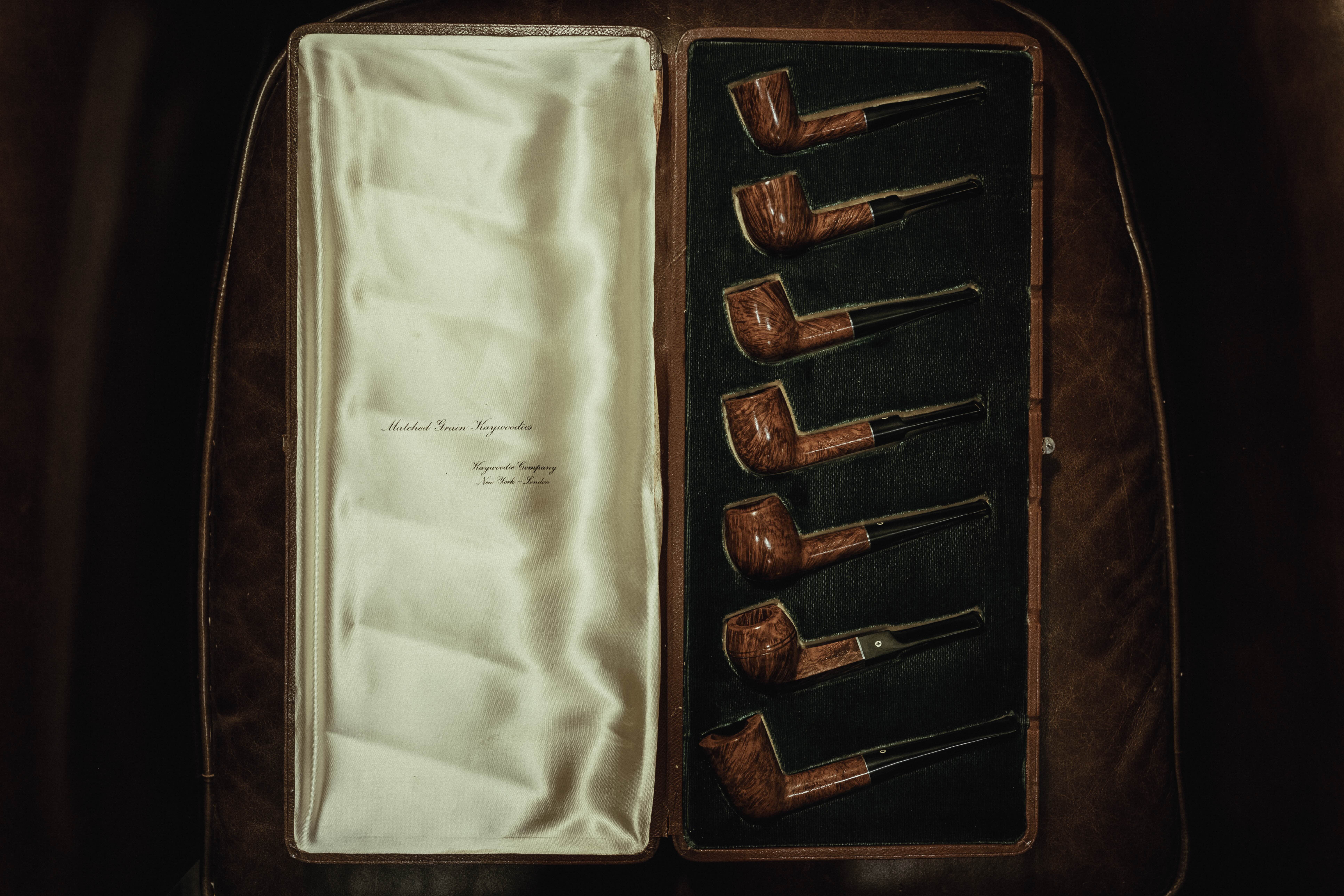
    Offered here is an exceptionally preserved and entirely unsmoked example dating to approximately 1939 to 1941, complete with its original New York–London presentation case. Opening the lid today is very much as it must have been nearly ninety years ago. The satin interior still bears the elegant inscription, “Matched Grain Kaywoodies” above “Kaywoodie Company, New York–London,” while beneath rest seven untouched pipes assembled as a complete week’s companionship for the thoughtful smoker.

    The old pipe men taught that a briar should be granted proper rest between smokes. One pipe each evening, six days of repose before returning once more to service. The seven-day set was therefore not simply a collection of pipes, but a philosophy of pipe smoking itself. One selected the proper companion according to the day, the mood, the weather, or perhaps the newspaper lying nearby. The remaining pipes waited patiently for their appointed hour.

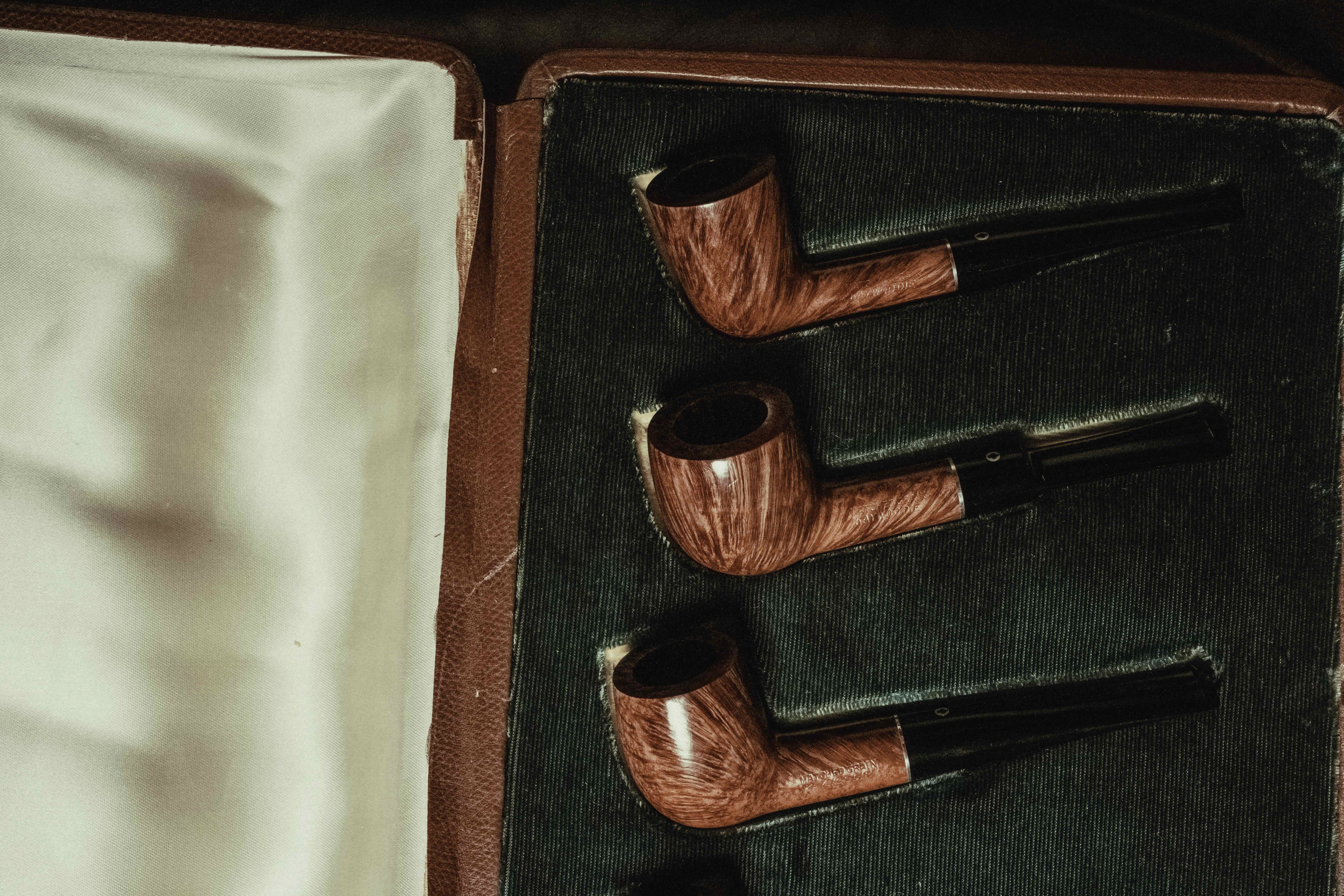
    The shapes represented in this set are 24, 95B, 85, 93B, 33, 12B, and 13. Together they display the remarkable success of Kaywoodie’s undertaking. Flame grain rises through one bowl and reappears in another. Birdseye gathers at the heels. The coloration, texture, and overall harmony of the pipes reveal the extraordinary effort required to assemble such a set. Nearly ninety years later the achievement remains plainly visible.

    Most remarkable of all is the fact that these pipes remain unsmoked. The bowls are untouched. The chambers remain clean and fresh. The original white clover inlays are bright and crisp. Each pipe retains its original four-hole Drinkless stinger bearing both the Drinkless designation and REG. NO. 213598 stamping.

    The original New York–London case survives remarkably well after nearly nine decades. The exterior exhibits the honest signs of age one would expect from a luxury presentation case of this period, including light surface wear, scattered scratches, and minor areas of finish loss. The interior remains highly attractive, retaining its satin lid and green flocked lining, though there is some localized lifting and peeling consistent with the natural aging of the original materials. These minor imperfections are entirely in keeping with the age of the set and do little to diminish the remarkable survival of the original presentation.

    One can easily imagine this very set resting upon a desk in 1940. Perhaps in the office of an attorney after the final client had departed. A physician returning home after his rounds. A banker, an editor, a professor, or a company president settling into the evening chair while the radio carried dance music from another room. Outside the world moved steadily onward. Inside, time seemed willing to pause.

    Many seven-day sets did not survive intact. Pipes became separated from their cases. Individual examples were sold. Others were smoked for decades until only fragments remained. Here the complete presentation endures. The original case remains with the set and displays the honest evidence of nearly ninety years of careful preservation. Minor wear to the exterior covering, light scratches, and small areas of lifting to portions of the interior lining speak not to neglect, but simply to the passage of time. Against this backdrop, the untouched condition of the pipes themselves becomes all the more remarkable.

    The years that followed would change the world. War would come. Materials would become scarce. Manufacturing priorities would shift. The elegant prewar age of American pipe making would slowly give way to something different. Yet this set survives exactly as it did before those changes arrived.

    The New York–London designation speaks to an era when Kaywoodie presented itself as an international luxury brand. The slender stems, delicate proportions, and early four-hole Drinkless stingers belong to the final years before wartime austerity and postwar production changes altered both the industry and the character of its products.

    Perhaps that is why these sets exert such fascination today. They belong to another age. An age of railway travel, evening newspapers, radio orchestras, handwritten correspondence, and the quiet confidence of a well-made object intended to last a lifetime.

    The pipe has often been called the aristocrat of the smoking world.

    Among Kaywoodies, the Matched Grain Seven-Day Set may well be the aristocrat among pipes.

    This very set was featured on my YouTube channel, Pipe Appeal, where it is presented in greater detail. The video may be viewed here:

    youtube.com/watch?v=0kU7xUWXhJ8&feature=youtu.be

    Details

    * Kaywoodie Matched Grain Seven-Day Presentation Set
    * Circa 1939–1941
    * Original New York–London fitted presentation case
    * Original satin lid and green flocked interior
    * Seven original unsmoked pipes
    * Left shank stamped “Matched Grain” over “Kaywoodie”
    * Right shank stamped “Imported Briar” and shape number
    * Shape numbers: 24, 95B, 85, 93B, 33, 12B, 13
    * White clover stem inlays
    * Four-hole Drinkless stingers
    * Drinkless and REG. NO. 213598 stamped stingers
    * Threaded Synchro-Stem fitments
    * Original case exhibits normal wear consistent with approximately 85 years of age
    * Pipes remain in extraordinary unsmoked condition
    * Please examine photographs and video carefully as they form part of the description

    Seller

    pbaggie12

    124 total auctions

    5 current auctions

    Auction Information

    Shipping: $22.16

    From: n/a

    To: n/a

    Late 1930s Kaywoodie Matched Grain Seven-Day Set, Unsmoked
    There are certain luxuries which belong entirely to a man himself. The evening newspaper. The favorite chair beside the lamp. The quiet hour after the day’s work has been completed and the demands of business have finally yielded to peace and reflection. In such moments the pipe has long occupied a place unlike any other possession, for no companion serves more faithfully nor rewards more generously than a good pipe chosen at the proper hour.

    During the closing years of the 1930s, when America was emerging from the hardships of the Depression and looking once more toward prosperity, the Kaywoodie Company introduced something that many pipe smokers had long believed impossible. For generations it had been accepted as fact that no two pipes could ever truly be alike. Each piece of briar possessed its own individuality, its own grain, its own character. Yet from immense reserves of carefully selected imported briar, accumulated over decades and drawn from ancient Mediterranean roots, Kaywoodie undertook the remarkable task of assembling pipes whose grain, color, texture, and appearance belonged not to themselves alone, but to one another.

    Thus was born the Matched Grain.

    The company itself admitted that it scarcely believed such a thing could be accomplished. Only from millions of pieces of briar, patiently sorted and reserved over many years, could a small number of truly matched pipes ever be assembled. From these extraordinary selections came perhaps the most ambitious offering in the company’s history: the Seven-Day Set.

    By 1937 these magnificent presentations were being offered to the American pipe smoker at the extraordinary price of one hundred dollars. Adjusted for inflation, that figure exceeds two thousand three hundred dollars today, placing the Matched Grain Seven-Day Set among the great luxury smoking articles of its day. At a time when many Americans still measured every dollar carefully, Kaywoodie openly acknowledged that only a fortunate few would ever possess one.

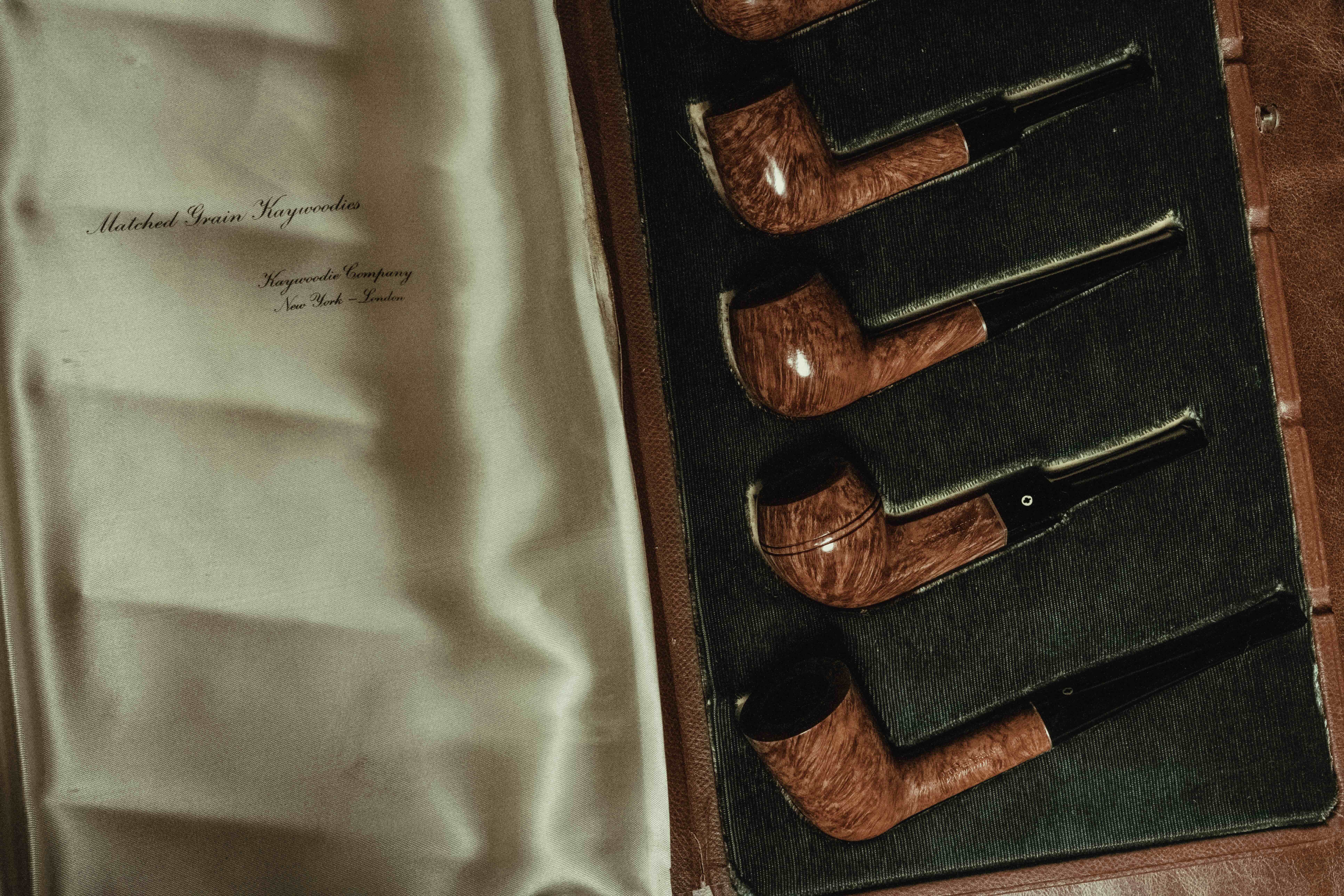
    Offered here is an exceptionally preserved and entirely unsmoked example dating to approximately 1939 to 1941, complete with its original New York–London presentation case. Opening the lid today is very much as it must have been nearly ninety years ago. The satin interior still bears the elegant inscription, “Matched Grain Kaywoodies” above “Kaywoodie Company, New York–London,” while beneath rest seven untouched pipes assembled as a complete week’s companionship for the thoughtful smoker.

    The old pipe men taught that a briar should be granted proper rest between smokes. One pipe each evening, six days of repose before returning once more to service. The seven-day set was therefore not simply a collection of pipes, but a philosophy of pipe smoking itself. One selected the proper companion according to the day, the mood, the weather, or perhaps the newspaper lying nearby. The remaining pipes waited patiently for their appointed hour.

    The shapes represented in this set are 24, 95B, 85, 93B, 33, 12B, and 13. Together they display the remarkable success of Kaywoodie’s undertaking. Flame grain rises through one bowl and reappears in another. Birdseye gathers at the heels. The coloration, texture, and overall harmony of the pipes reveal the extraordinary effort required to assemble such a set. Nearly ninety years later the achievement remains plainly visible.

    Most remarkable of all is the fact that these pipes remain unsmoked. The bowls are untouched. The chambers remain clean and fresh. The original white clover inlays are bright and crisp. Each pipe retains its original four-hole Drinkless stinger bearing both the Drinkless designation and REG. NO. 213598 stamping.

    The original New York–London case survives remarkably well after nearly nine decades. The exterior exhibits the honest signs of age one would expect from a luxury presentation case of this period, including light surface wear, scattered scratches, and minor areas of finish loss. The interior remains highly attractive, retaining its satin lid and green flocked lining, though there is some localized lifting and peeling consistent with the natural aging of the original materials. These minor imperfections are entirely in keeping with the age of the set and do little to diminish the remarkable survival of the original presentation.

    One can easily imagine this very set resting upon a desk in 1940. Perhaps in the office of an attorney after the final client had departed. A physician returning home after his rounds. A banker, an editor, a professor, or a company president settling into the evening chair while the radio carried dance music from another room. Outside the world moved steadily onward. Inside, time seemed willing to pause.

    Many seven-day sets did not survive intact. Pipes became separated from their cases. Individual examples were sold. Others were smoked for decades until only fragments remained. Here the complete presentation endures. The original case remains with the set and displays the honest evidence of nearly ninety years of careful preservation. Minor wear to the exterior covering, light scratches, and small areas of lifting to portions of the interior lining speak not to neglect, but simply to the passage of time. Against this backdrop, the untouched condition of the pipes themselves becomes all the more remarkable.

    The years that followed would change the world. War would come. Materials would become scarce. Manufacturing priorities would shift. The elegant prewar age of American pipe making would slowly give way to something different. Yet this set survives exactly as it did before those changes arrived.

    The New York–London designation speaks to an era when Kaywoodie presented itself as an international luxury brand. The slender stems, delicate proportions, and early four-hole Drinkless stingers belong to the final years before wartime austerity and postwar production changes altered both the industry and the character of its products.

    Perhaps that is why these sets exert such fascination today. They belong to another age. An age of railway travel, evening newspapers, radio orchestras, handwritten correspondence, and the quiet confidence of a well-made object intended to last a lifetime.

    The pipe has often been called the aristocrat of the smoking world.

    Among Kaywoodies, the Matched Grain Seven-Day Set may well be the aristocrat among pipes.

    This very set was featured on my YouTube channel, Pipe Appeal, where it is presented in greater detail. The video may be viewed here:

    youtube.com/watch?v=0kU7xUWXhJ8&feature=youtu.be

    Details

    * Kaywoodie Matched Grain Seven-Day Presentation Set
    * Circa 1939–1941
    * Original New York–London fitted presentation case
    * Original satin lid and green flocked interior
    * Seven original unsmoked pipes
    * Left shank stamped “Matched Grain” over “Kaywoodie”
    * Right shank stamped “Imported Briar” and shape number
    * Shape numbers: 24, 95B, 85, 93B, 33, 12B, 13
    * White clover stem inlays
    * Four-hole Drinkless stingers
    * Drinkless and REG. NO. 213598 stamped stingers
    * Threaded Synchro-Stem fitments
    * Original case exhibits normal wear consistent with approximately 85 years of age
    * Pipes remain in extraordinary unsmoked condition
    * Please examine photographs and video carefully as they form part of the description

    This auction contains a pipe.  If you live in Vermont, you will be unable to bid on this product.

    Bid History (1 Bid)

    # Amount Bidder Type Date
    1 $1,995.00 P***4 New 20 Jun 2026 @ 12:16:17am
    $1,995.00   Start 19 Jun 2026 @ 11:53:02pm

    Current Price

    1,995.00
    Reserve not met